
Designing a Digital Gateway for Adult Social Care
Empowering self-service support for people who are ineligible for council-funded support
-
Tools & Methods
Figma, MS Teams, MS Office, Float, Miro, Recruitment panel provider
User interviews (discovery + testing), thematic analysis, mid-fidelity prototyping (Figma), SME collaboration, iterative user testing (2 rounds)
-
Deliverables
User requirements
Recommendations & actions
User stories
Mid-fidelity clickable wireframe prototype
-
My roles
Facilitating SME workshops
Discussion guide writing
Leading discovery interviews & user testing sessions
Prototype development
Thematic analysis of findings
Project Context
The latest figures show that in 2024/25, the UK Government spent £25.5 billion on adult social care. However, the positive impact of this funding, both on individuals’ lives and the wider economy, is being undermined. Local authorities are unable to allocate sufficient resources toward preventative care to reduce the number of people getting ill in the first place, and are instead being forced to prioritise complex health and social care support for people leaving hospital. This, combined with high staff turnover in both primary and secondary care, led to an estimated £15 million worth of missed care opportunities, which is support that could have helped people remain independent at home, assisted carers, and created valuable jobs.

The Challenge
To address this, I worked alongside another UX consultant and project QA to research, design, and test a proof of concept digital gateway for local authorities providing adult social care. The development of an Adult Social Care gateway would play a key role in helping the Government achieve its ambition of becoming a digital nation. It would also enable local authorities to provide proactive support and guidance (rather than reactive), whilst also generating savings that could be reinvested into other vital services.
A November 2024 report by the Local Government Association highlighted that investing in preventative support can save approximately £3.17 for every £1 spent by maximising the use of available resources, addressing ‘whole community needs’, and reducing the demand for higher cost acute health and social care services.

Goals
The aim was to design and test a small-scale prototype that can act as a proof of concept - demonstrating the viability of a self service platform for Adult Social Care and informing future development. The research questions included:
What are the key features a digital adult social care gateway should include to support and empower users to self-serve?
How do users respond to the proposed features, flows, and functionality designed to guide them through self-service support options?

Discovery Methodology
Discovery Interviews
We conducted 11 x 60 minute semi-structured interviews with individuals who had recently been assessed as ineligible for council-funded care:
4 individuals aged 65+.
4 individuals under 65.
3 relatives/friends supporting someone with care needs.
The aim was to understand the overall process of applying for adult social care, uncover their needs, frustrations, and expectations when navigating support independently, as well as gauge their acceptance level for a digital gateway platform.

Designing & Testing
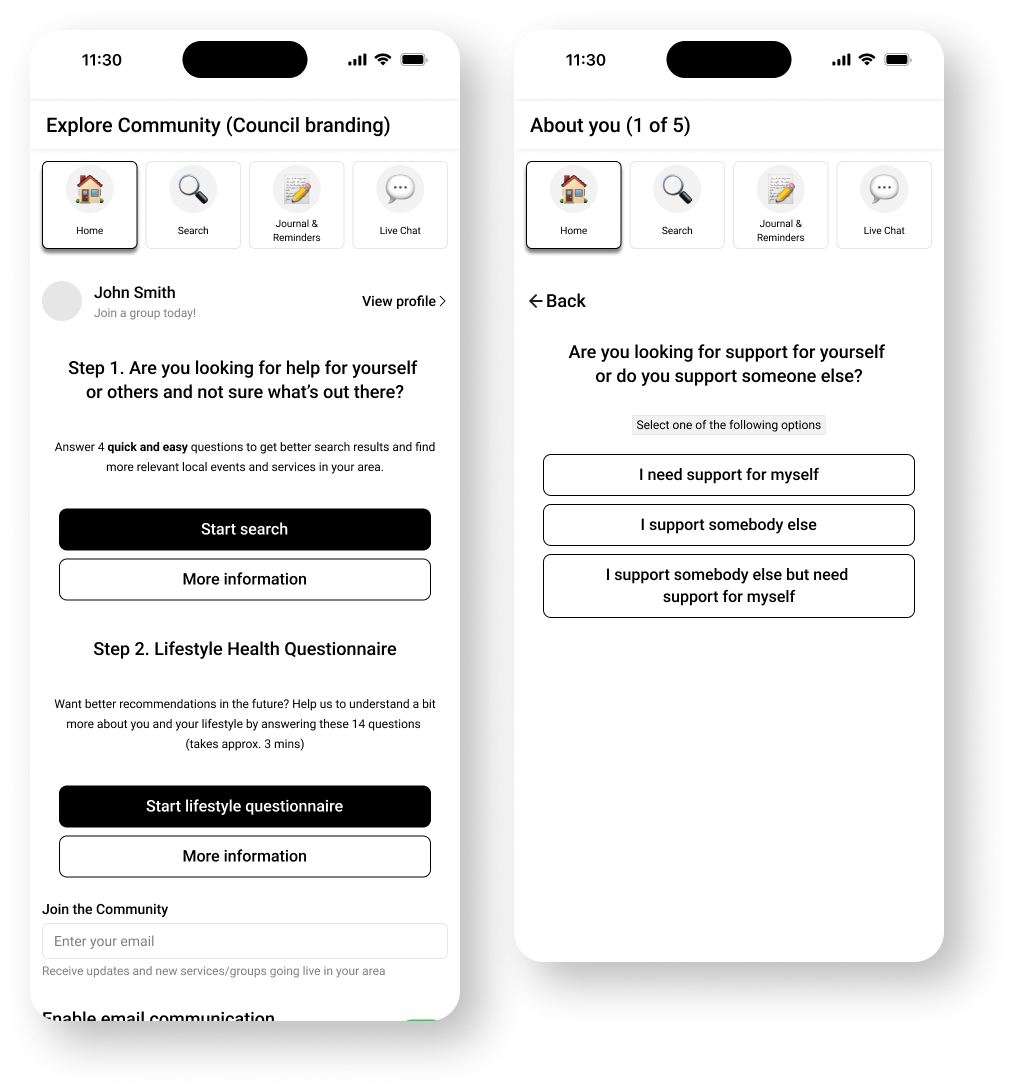
Prototype v1: Initial Wireframes
Based on discovery insights, I created a mid-fidelity prototype to explore and test key journeys, including:
Designing two questionnaires to test the concept of one, producing in-app recommendations based on the challenges the user has and the type of support they’re looking for (e.g. activity or support group) and two, preventative suggestions based on lifestyle factors (e.g. exercise frequency, food choices, alcohol and smoking habits).
User Testing: Round One
I tested the initial prototype with 6 users who had recently been assessed as ineligible for council-funded care:
2 aged 65+
2 under 65
2 relatives/friends supporting someone with care needs.
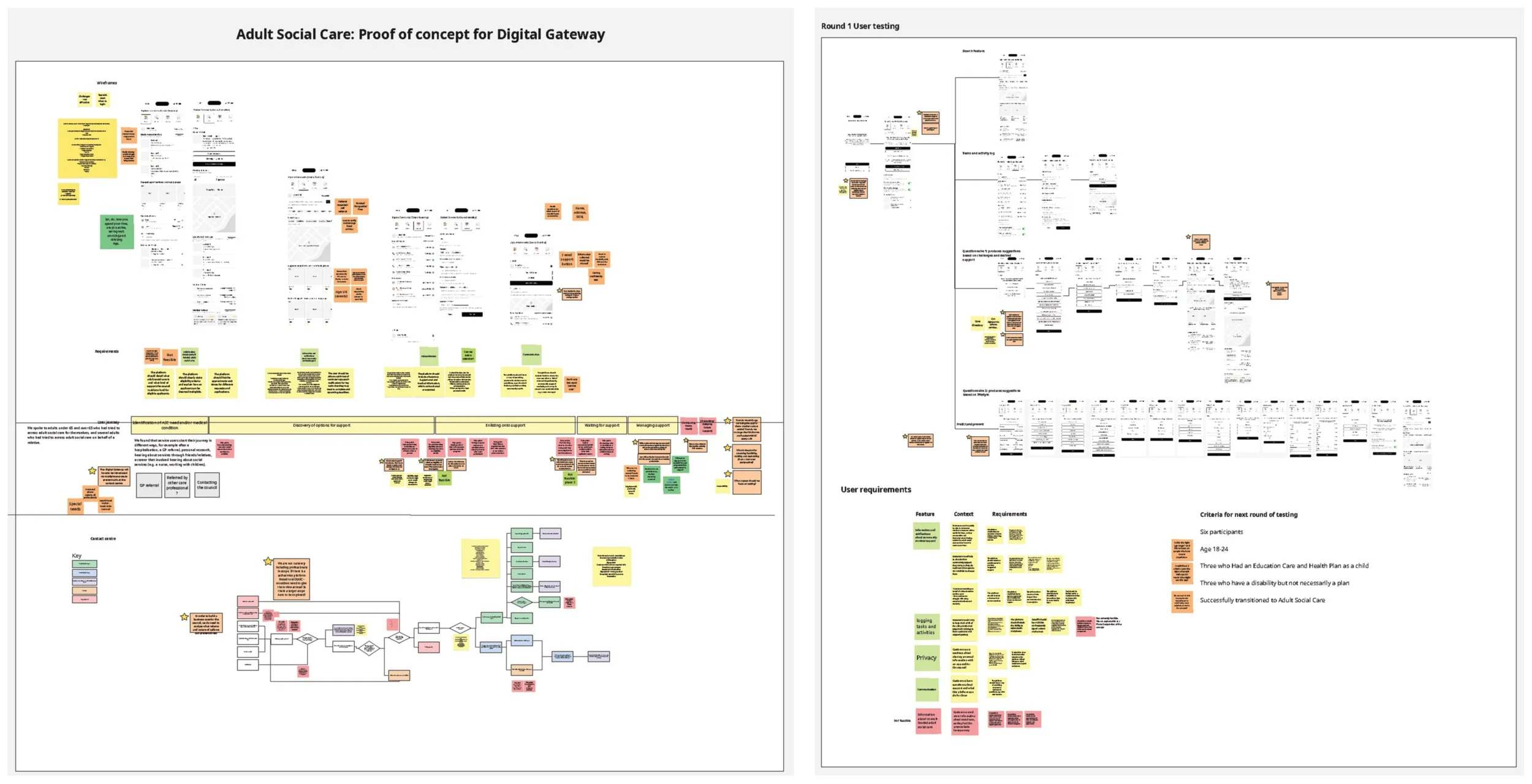
I shared the findings from this round of testing during a workshop with in-house SMEs (pictured below) to understand the back-end process of applying for adult social care, which features were feasible for development, and next steps for round two of user testing.
Prototype v2: Mid-Fidelity (Figma)
I refined the prototype in Figma, incorporating client feedback, SME feedback and the following usability improvements from round one of the user testing:
Gave users the ability to favourite certain providers, groups or activities shown to them in the search results / suggestions.
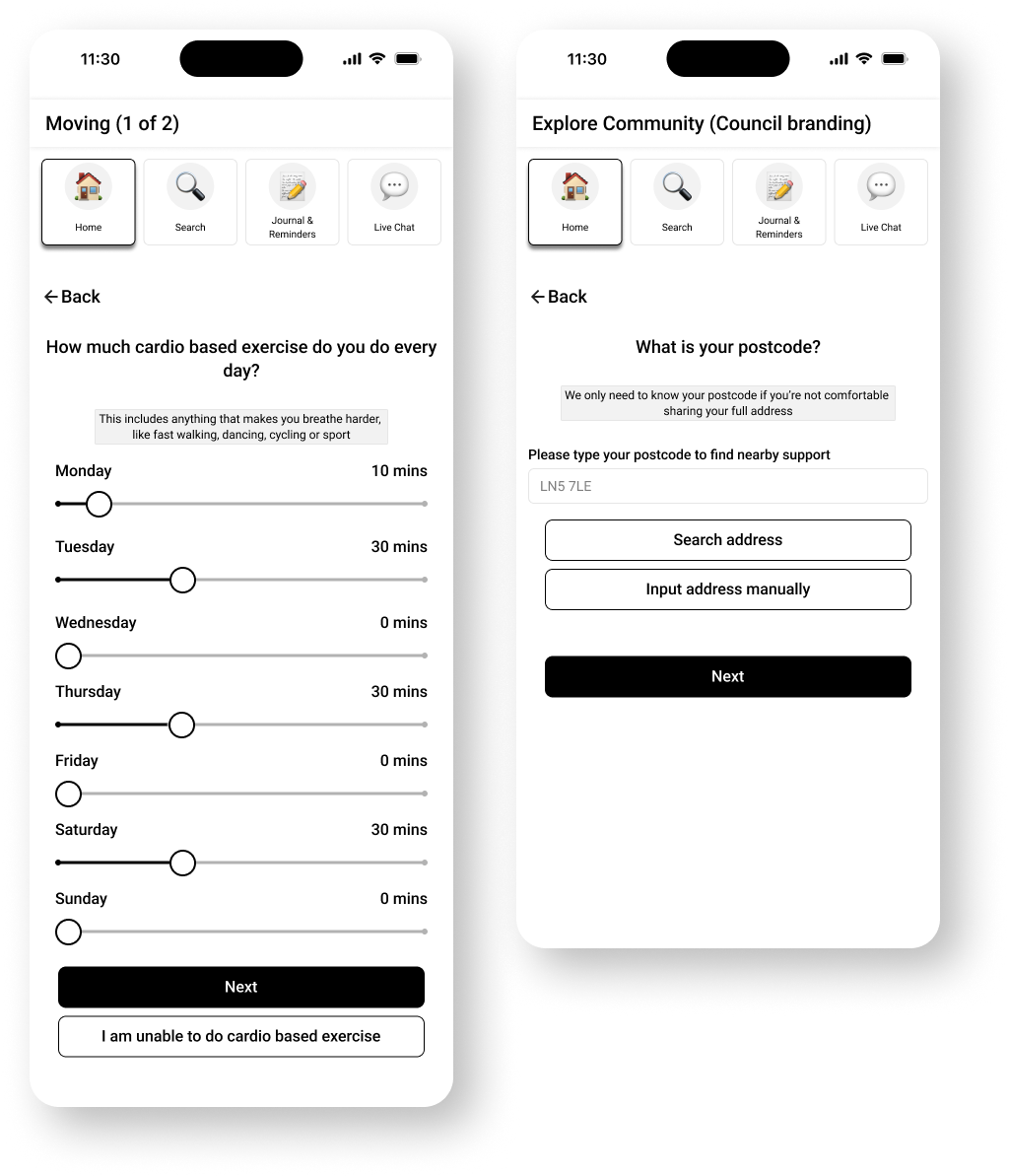
Included accessibility options in both the search result filters and questionnaire answers (e.g. avoiding irrelevant suggestions by adding an option for ‘I am unable to to cardiovascular exercise’ on physical activity based questions).
Highlighted data privacy measures and gave users the option input their location based only on their postcode rather than full address (some users were concerned that any information they used to search or log may effect their eligibility for other council support and benefits if it were shared outside of the app)
Increase understanding by changing certain navigation titles to more accurately reflect the content of that section (e.g. changing the title of the section where users can manually log their activities and correspondence with social care providers from ‘reminders’ to ‘journal & reminders’.
User Testing: Round Two
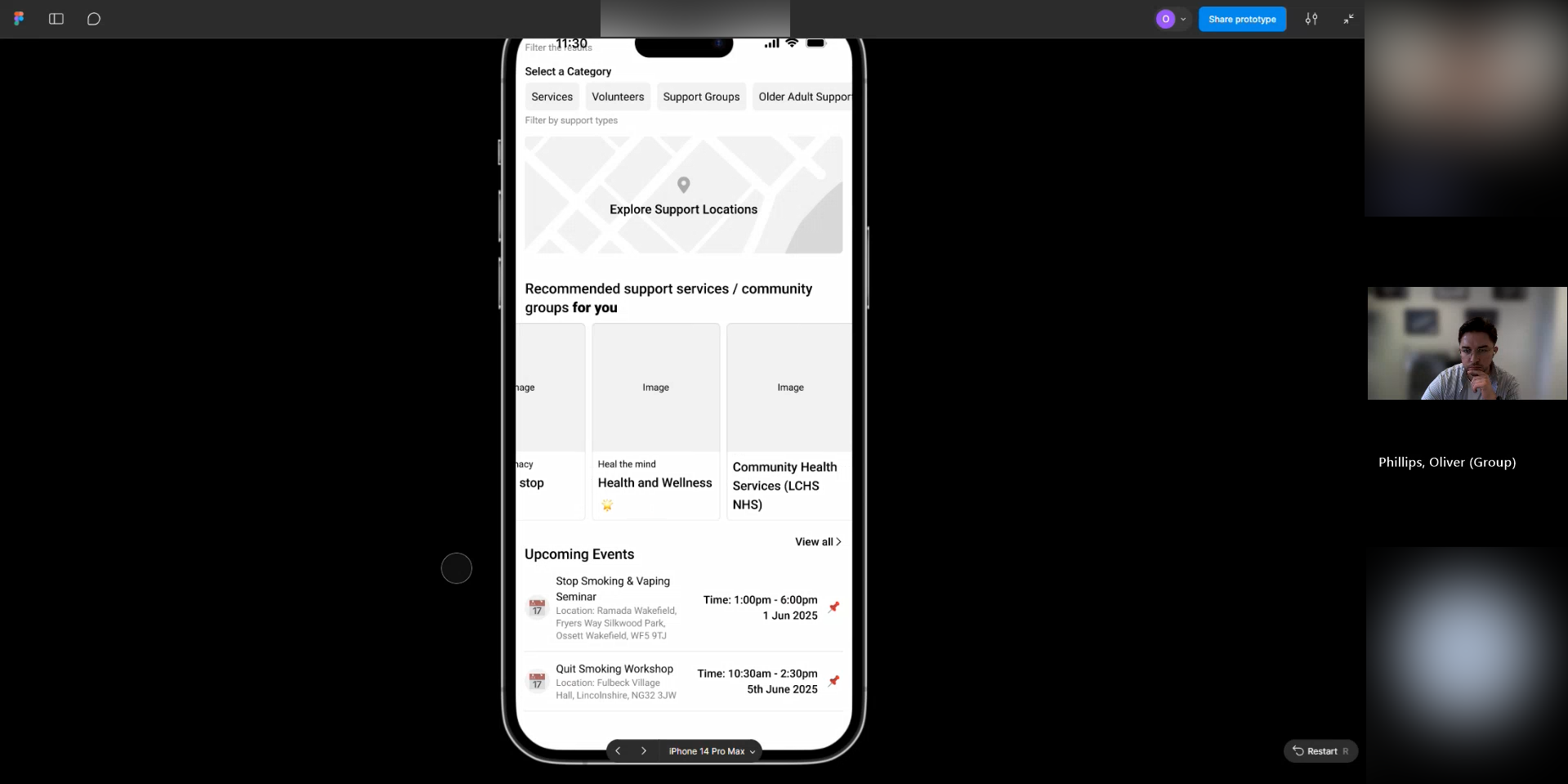
Following the SME workshop, I validated the revised prototype with 6 new participants using an updated discussion guide. In order to gain more valuable feedback/insights around a digital product, I focused round two on participants aged 18–23. These users had:
Recently been assessed as ineligible for council-funded care.
Either recently transitioned from child to adult social care, or
Been recommended to complete a needs assessment.
Outcomes & Impact
Validated Prototype
We delivered a mid-fidelity clickable prototype (shown below) built in Figma that reflected the needs, behaviours, and preferences of vulnerable real-world users, an excel spreadsheet listing user stories and UX requirements (shown bottom), and a spreadsheet listing all insights gathered from discovery through to round 2 of user testing (shown right). This proof of concept demonstrated how a digital gateway could help people who are ineligible for council-funded care to:
Independently find information about support groups, services, events and providers in their area.
Discover alternative support through needs based and lifestyle questionnaires.
Understand their eligibility and next steps.
Keep track of any correspondence with service providers.
This proof of concept also demonstrated how a digital gateway to adult social care could help local authorities:
Reduce the number of calls from users on waitlists or awaiting eligibility assessment results (sometimes taking up to 18 months) by providing users with access to alternative community based support.
More effectively use preventative support through social prescribing (the lifestyle health based questionnaire connects people to non-clinical services and activities in their community to improve their health and well-being before they get worse and need to access more costly acute health services in the future).
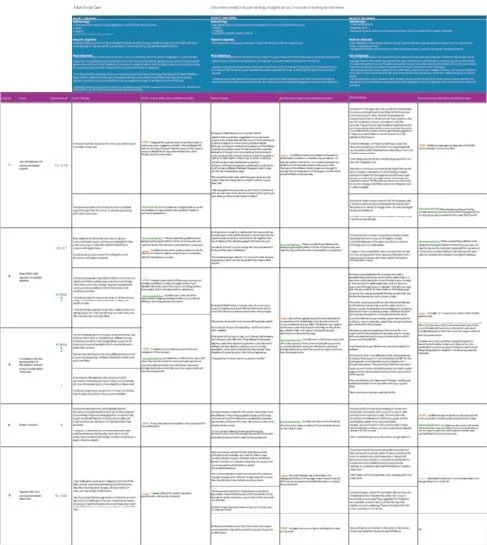
Shown above is an Excel spreadsheet listing all insights gathered from discovery through to round 2 of user testing
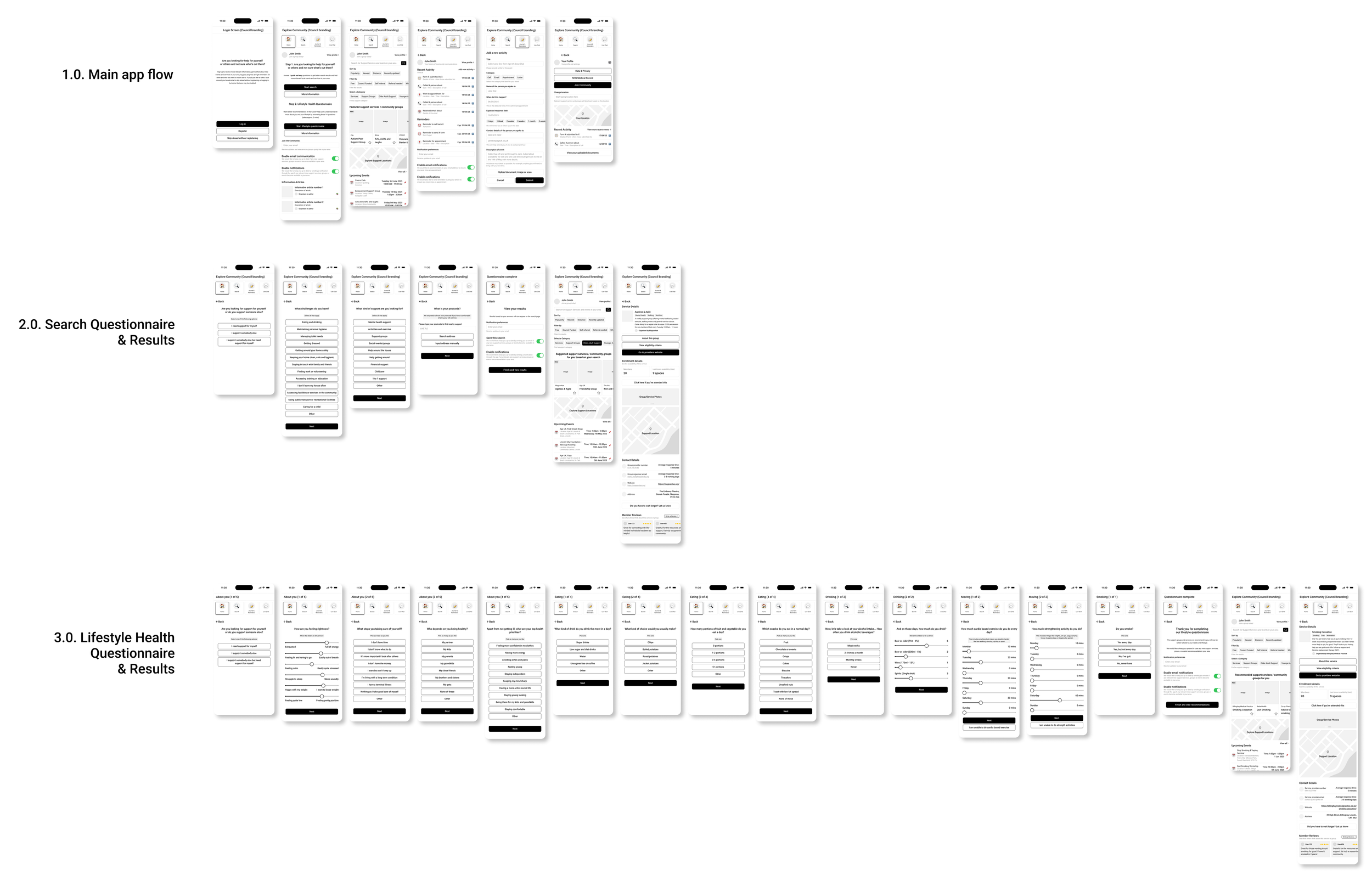
Shown above is a mid-fidelity clickable prototype of the social care digital gateway built in Figma that reflects the needs, behaviours, and preferences of vulnerable real-world users.
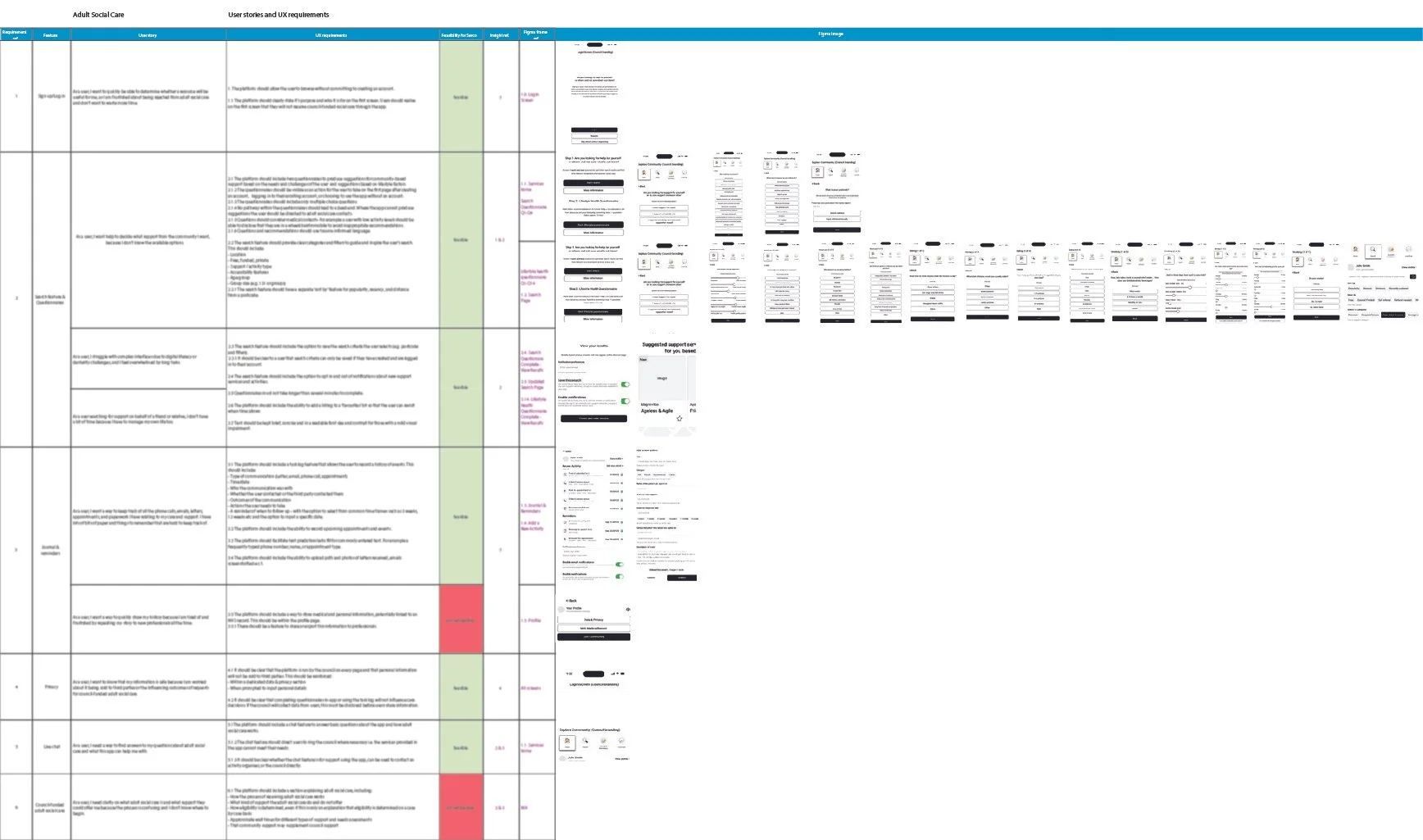
Shown above is an excel spreadsheet listing user stories and UX requirements
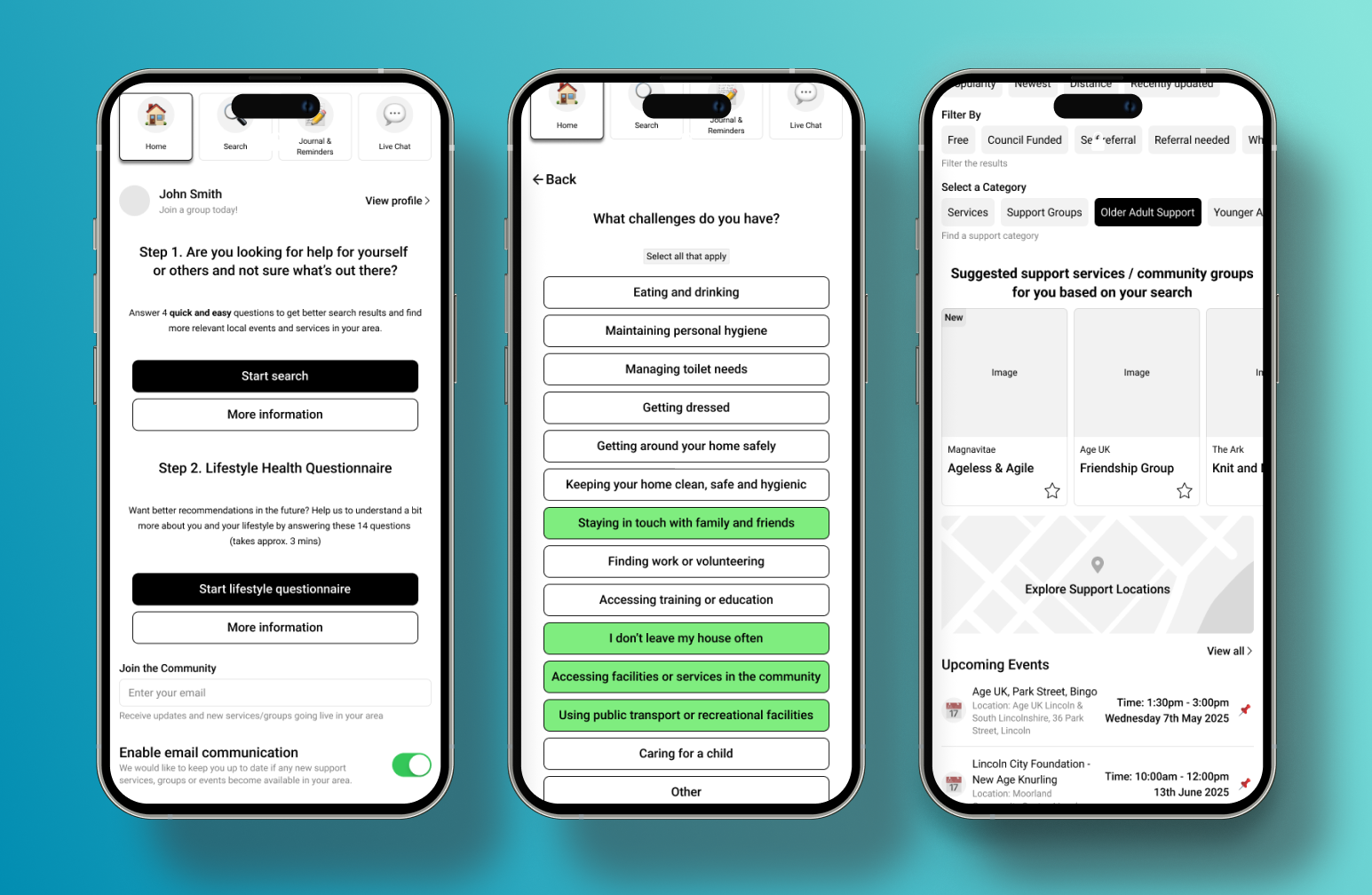
Shown above is a mock up of the mid-fidelity clickable prototype built in Figma that reflects the needs, behaviours, and preferences of vulnerable real-world users.